
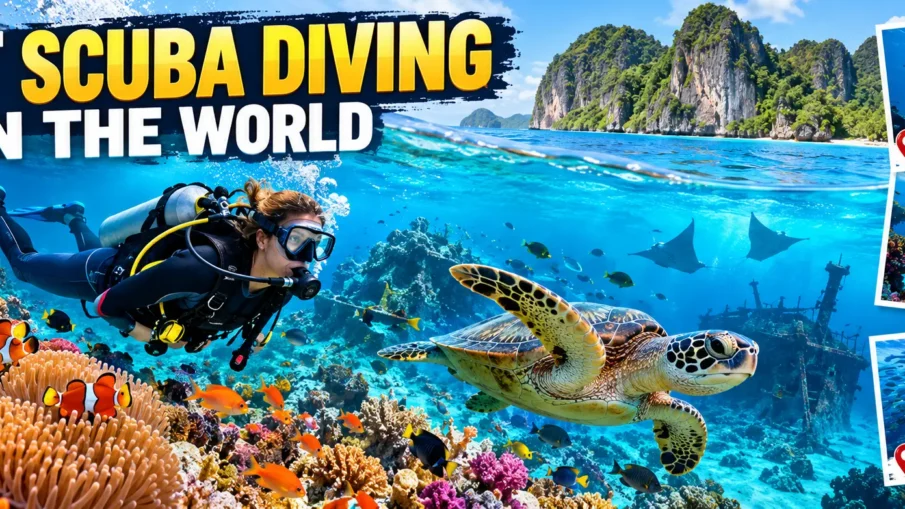
Choosing where to experience the best scuba diving in the world depends on what you want to find below the surface. Some travelers dream of colorful coral reefs and warm tropical water, while others want manta rays, sharks, shipwrecks, dramatic walls, or huge schools of fish. Your experience level matters too, since a calm Caribbean reef offers a very different trip from a remote site known for powerful currents.
Fortunately, excellent diving exists across the Caribbean, Pacific, Indian Ocean, Red Sea, and beyond. Rather than looking for one destination that is supposedly perfect for everyone, it makes more sense to compare marine life, underwater terrain, seasonal conditions, accessibility, and the type of diving each place offers.
Best Scuba Diving in the World: Quick Destination Guide
Each destination has its own strengths. Therefore, this quick comparison can help you identify which locations deserve a place on your travel shortlist.
| Destination | Known For | Suitable For | Trip Style |
|---|---|---|---|
| Raja Ampat, Indonesia | Reef biodiversity | Experienced divers | Remote adventure |
| Great Barrier Reef, Australia | Vast coral reef system | All levels | Resort or liveaboard |
| Maldives | Mantas, sharks, channels | All levels depending on site | Resort or liveaboard |
| Belize | Barrier reef, walls, Blue Hole | Intermediate and advanced | Island-based |
| Hawaii, USA | Mantas, turtles, volcanic terrain | All levels | Island vacation |
| Cozumel, Mexico | Drift diving, walls | Intermediate-friendly | Easy Caribbean getaway |
| Red Sea, Egypt | Reefs and wrecks | All levels | Resort or liveaboard |
| Costa Rica | Sharks, rays, pelagic life | Intermediate and advanced | Adventure trip |
| Bahamas | Sharks, reefs, clear water | All levels | Island vacation |
| Turks and Caicos | Walls, clear water, reefs | All levels | Relaxed Caribbean trip |
While this table provides a starting point, conditions vary between individual dive sites. Consequently, travelers should always check current local conditions and certification requirements before booking.
Raja Ampat, Indonesia: Exceptional Reef Biodiversity
Raja Ampat regularly appears in conversations about the best scuba diving destinations in the world, especially among travelers interested in marine biodiversity.
Located in eastern Indonesia, this remote archipelago features coral gardens, walls, pinnacles, and reefs filled with marine life. Divers may encounter dense schools of fish, reef sharks, rays, turtles, and a remarkable variety of smaller species.
However, Raja Ampat requires more planning than an easy resort destination. Reaching the region usually involves multiple stages of transportation, while liveaboards and remote dive resorts can raise the overall cost.
Currents also vary considerably. Therefore, although some sites may offer manageable conditions, experienced divers often get more from the destination because they can comfortably explore a broader selection of locations.
If underwater biodiversity ranks above nightlife, shopping, and conventional sightseeing on your priorities, Raja Ampat is difficult to ignore.
Belize: Barrier Reefs and the Famous Blue Hole
Belize offers one of the Caribbean’s most recognizable diving environments. Its barrier reef system provides coral formations, walls, marine life, and a range of sites accessible from popular island bases.
Ambergris Caye and Caye Caulker are common starting points. Meanwhile, more experienced divers may be interested in the Great Blue Hole, although its depth and profile mean it should not automatically be treated as the best option for every visitor.
In fact, many travelers find Belize’s reefs and walls more colorful and varied than a single bucket-list dive.
Seasonal conditions can affect the overall vacation as well. Therefore, checking the best time to visit belize is useful when coordinating diving with weather, island activities, and your wider travel plans.
Great Barrier Reef, Australia
Few underwater destinations are as famous as Australia’s Great Barrier Reef. Because the reef system covers such a large area, however, the experience varies significantly depending on where you go.
Cairns and Port Douglas are convenient gateways for many travelers. Day boats provide straightforward access, while liveaboards can reach more distant locations and allow several dives across a shorter period.
Beginners can find supervised experiences at suitable sites. Meanwhile, certified and experienced divers have access to a much wider selection of reefs and itineraries.
Marine life varies by location, yet divers may encounter turtles, reef fish, rays, sharks, and diverse coral formations.
Rather than choosing a trip based only on the words “Great Barrier Reef,” compare the actual sites included in each operator’s itinerary.
Maldives: Manta Rays, Channels, and Tropical Reefs
The Maldives combines resort travel with an enormous variety of underwater environments. Therefore, it works particularly well for travelers who want both a relaxing island holiday and several days of scuba diving.
Reef dives can offer colorful fish, turtles, and other tropical marine life. Meanwhile, particular areas are known for manta rays and whale sharks at certain times.
Channels can produce exciting marine encounters, although they may also bring stronger currents. As a result, divers should match individual sites to their experience level.
Liveaboards are especially appealing to travelers whose main purpose is scuba diving. In contrast, a resort with a house reef may work better for couples or families who want diving to form only one part of the vacation.
Hawaii: Volcanic Landscapes and Manta Encounters
Hawaii offers some of the best places in the world for scuba diving for travelers who want an underwater trip combined with hiking, beaches, scenic drives, and other activities.
The Big Island is particularly famous for manta experiences. Maui, meanwhile, offers volcanic underwater terrain and reef diving, while Oahu provides a mix of reefs and wrecks.
The islands also work well for mixed groups because non-divers have plenty of alternatives. Therefore, one person can spend the morning underwater while other travelers explore beaches or attractions.
Ocean conditions change throughout the year, though. If Hawaii is on your shortlist, researching when is the best time to go to hawaii can help you coordinate weather, ocean conditions, prices, and other island activities.
Cozumel, Mexico: Classic Caribbean Drift Diving
Cozumel attracts divers with clear Caribbean water, reef walls, and its signature drift dives. Instead of swimming continuously against the water, divers often allow the current to carry them along the reef.
That style can feel effortless under suitable conditions. However, good buoyancy and comfort with currents make the experience more enjoyable.
Cozumel also has practical advantages. The island offers plenty of hotels and restaurants, while dive operators serve travelers with different budgets and experience levels.
Since the destination is relatively easy to combine with mainland Mexico, it also works well for travelers who do not want an entire vacation centered around diving.
Red Sea, Egypt: Reefs and Historic Wrecks
Egypt’s Red Sea offers a compelling combination of clear water, coral reefs, walls, and wreck diving. Sharm El Sheikh, Hurghada, and Marsa Alam are among the best-known bases, although the experience differs between regions.
Beginners can find suitable reef sites, while advanced divers can choose more demanding locations. Meanwhile, wreck enthusiasts often plan trips specifically around famous Red Sea wrecks.
Liveaboards allow serious divers to reach locations that may be difficult to access efficiently on daily boat trips. Still, resort-based diving makes more sense for travelers who want a flexible vacation with fewer days entirely devoted to the water.
When comparing operators, check the actual route rather than simply choosing the cheapest package.
Costa Rica: A Different Kind of Tropical Diving
Costa Rica offers a different experience from destinations dominated by postcard-perfect coral reefs. Along its Pacific coast, divers often focus more heavily on larger marine species and dramatic underwater terrain.
Depending on the region and season, possible encounters include rays, turtles, sharks, and large schools of fish. Visibility, however, can vary considerably.
That unpredictability is part of the destination’s character. Consequently, Costa Rica tends to suit travelers who value marine encounters and adventure more than consistently crystal-clear water.
Since rainfall patterns can affect the rest of your itinerary, review the best time to visit costa rica before deciding when to travel. This is especially useful if you plan to combine scuba diving with rainforests, beaches, wildlife watching, or inland adventures.
Bahamas: Clear Water and Shark Diving
The Bahamas has long appealed to divers because of its clear water, reefs, walls, wrecks, and opportunities to see sharks.
Different islands provide different experiences. Therefore, choosing the right base matters more than simply booking a generic Bahamas diving vacation.
Some locations cater to casual vacation divers, while others attract travelers specifically interested in shark encounters or liveaboard itineraries. Beginners can also find appropriate options when conditions and supervision are suitable.
Weather can affect boat schedules and visibility, so trip timing deserves attention. Checking the best time to visit bahamas can help you balance diving conditions with rainfall, storm-season considerations, crowds, and accommodation prices.
Turks and Caicos: Walls and Clear Caribbean Water
Turks and Caicos is known for clear tropical water, coral reefs, and dramatic wall diving. Grand Turk and Providenciales provide access to different underwater environments, while several smaller islands offer quieter experiences.
The destination can suit both relatively new and experienced divers because operators can select sites according to ability. Still, currents, depth, and weather vary, so individual site selection remains essential.
Above water, the islands lean toward a relaxed beach-vacation experience. Consequently, they work particularly well for couples or families who want high-quality diving without making every day of the trip about scuba.
Before booking accommodation and dive packages, compare seasonal conditions using a guide to the best time to visit turks and caicos, especially if flexible travel dates allow you to avoid busier or wetter periods.
Where Is the Best Scuba Diving in the World for Beginners?
New divers should look beyond famous destination names and focus on actual dive conditions.
A beginner-friendly site usually offers manageable currents, comfortable entry and exit points, appropriate depths, good professional supervision, and predictable conditions. Consequently, destinations such as Bonaire, Hawaii, the Red Sea, the Maldives, and Australia’s Great Barrier Reef can all provide beginner options when the correct sites are selected.
However, those same destinations may contain advanced dives nearby. For instance, a calm Maldivian reef and a fast-moving channel should not be treated as equivalent simply because both are in the Maldives.
Therefore, tell the dive center exactly how much experience you have. A responsible operator can then recommend suitable sites rather than placing you on a trip designed for more experienced divers.
How to Choose Between the Best Scuba Diving Spots in the World
First, decide what kind of underwater experience excites you most. Coral enthusiasts may prioritize Raja Ampat or the Great Barrier Reef, whereas travelers interested in mantas could look toward the Maldives or Hawaii.
Next, consider travel difficulty. A remote destination may offer exceptional diving, yet reaching it can require domestic flights, ferries, and boat transfers. Conversely, destinations such as Cozumel can be easier to incorporate into a conventional vacation.
Your budget matters as well. Calculate flights, accommodation, equipment rental, dive packages, marine fees, transfers, meals, insurance, and tips rather than comparing dive prices alone.
Finally, be realistic about your experience. A destination becomes far more enjoyable when the conditions match your abilities.
When Should You Book a World-Class Diving Trip?
There is no single worldwide scuba season. Instead, each destination has its own patterns of rainfall, wind, water temperature, visibility, currents, and marine activity.
Likewise, famous wildlife encounters can be seasonal. Manta rays, whale sharks, schooling fish, and other species may be more frequently observed during particular periods.
However, wildlife is never guaranteed. Therefore, plan around generally favorable conditions first and treat specific animal encounters as a possible highlight rather than a promise.
Booking early can help with popular liveaboards and remote resorts, especially during peak diving periods. On the other hand, flexible travelers may sometimes find better accommodation rates outside the busiest months.
Practical Tips Before Your Scuba Vacation
Check your certification requirements before paying for a non-refundable package. Likewise, ask whether specific dives require minimum logged dives, advanced certification, nitrox training, or previous current-diving experience.
If you rent equipment, confirm what the package actually includes. Some operators include weights and tanks but charge separately for items such as computers, wetsuits, or regulators.
Also, consider travel insurance that appropriately covers your planned scuba activities. Policy conditions differ, so read depth, certification, and activity restrictions carefully.
Most of all, leave some flexibility in the itinerary. Ocean conditions can change quickly, and responsible operators may alter or cancel dives when conditions are unsuitable.
FAQs About the World’s Best Scuba Diving
Where is the best scuba diving in the world?
Raja Ampat is famous for reef biodiversity, the Maldives for mantas and channels, the Red Sea for reefs and wrecks, and the Great Barrier Reef for its enormous scale. Meanwhile, destinations such as Hawaii, Belize, and the Bahamas combine good diving with easy vacation options.
What are the best scuba diving destinations in the world for marine life?
Raja Ampat, the Maldives, Australia’s Great Barrier Reef, Costa Rica, and several Pacific destinations are strong choices for marine-life-focused trips. However, the species you may encounter depend on season, location, and natural conditions.
Is Caribbean scuba diving good for beginners?
Yes, many Caribbean destinations offer beginner-friendly sites. Bonaire, Cozumel, Belize, the Bahamas, and Turks and Caicos all have options for less experienced divers, although not every individual site is suitable for beginners.
Is a liveaboard better than a dive resort?
A liveaboard usually makes sense when scuba diving is the main purpose of the trip because it can provide multiple daily dives and access to more distant sites. In contrast, a resort is often better for mixed groups, couples with different interests, or travelers who want more time on land.
Plan Around the Experience You Actually Want
The best scuba diving in the world can mean floating above an Indonesian coral garden, watching mantas in the Maldives, exploring a Red Sea wreck, drifting along a Cozumel reef, or descending beside a Caribbean wall.
Instead of chasing a universal number-one destination, match your trip to your certification, preferred marine life, budget, available time, and comfort with different underwater conditions. Then, check the season, research reputable operators, and build enough flexibility into your itinerary to accommodate the ocean. That approach gives you a much better chance of returning home with the kind of diving memories you actually wanted.