
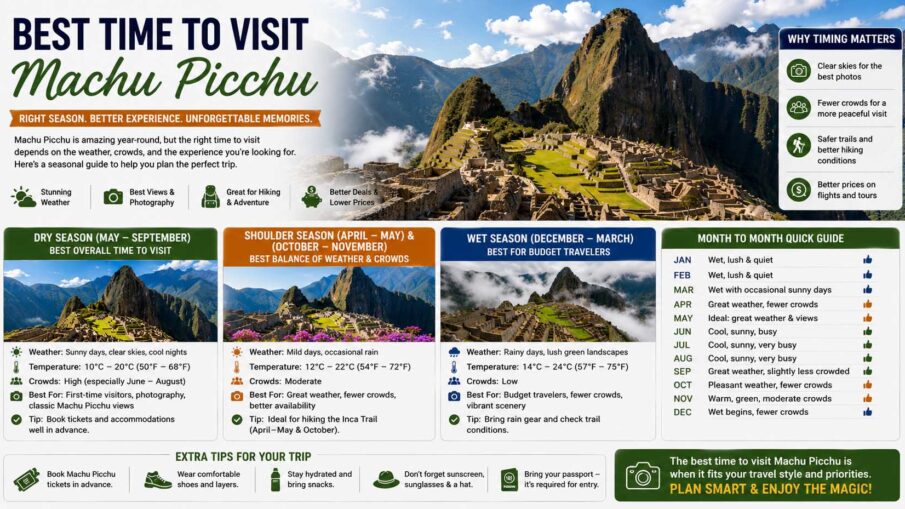
The best time to visit Machu Picchu is generally during Peru’s dry season from May through September, especially if clear skies and hiking conditions are your priorities. However, June through August also brings heavier visitor demand. For travelers who want a better balance between weather and crowds, April, May, September, and October can be excellent choices. Meanwhile, the wetter months offer greener scenery and potentially quieter travel, although rain can disrupt outdoor plans.
Choosing the right month matters because Machu Picchu sits high in the Andes, where conditions can change quickly. Instead of looking only for the driest weather, consider crowds, trail conditions, ticket availability, transportation, and the rest of your Peru itinerary.
When Is the Best Time to Visit Machu Picchu?
For most first-time visitors, May, September, and early October provide an appealing combination of generally favorable weather and somewhat less peak-season pressure than the busiest winter months.
May falls near the beginning of the dry season. Therefore, the landscape can still look lush after the wetter months, while rainfall generally becomes less frequent.
June, July, and August are popular because they fall within the dry season. However, mornings and nights can feel quite cold, particularly at higher elevations. Meanwhile, strong demand means travelers should plan tickets, trains, and accommodation carefully.
September remains attractive because conditions are often suitable for sightseeing while the busiest vacation period starts easing.
Since Machu Picchu is only one part of a much larger country, travelers building a broader itinerary should also consider the best time to visit Peru. Weather conditions on the coast, in the Andes, and in the Amazon can differ greatly during the same month.
Machu Picchu Best Time to Visit by Season
Machu Picchu generally has a drier season and a wetter season rather than four sharply defined seasons.
Here is a quick planning overview:
| Period | Typical conditions | Crowds | Best for |
|---|---|---|---|
| April–May | Rain decreasing, greener scenery | Moderate | Balanced trips |
| June–August | Drier, sunnier days, cold nights | High | Hiking and clearer views |
| September–October | Transition toward wetter weather | Moderate | Weather-crowd balance |
| November–March | Wetter and cloudier | Lower overall | Green scenery, flexible travelers |
Weather in the Andes remains unpredictable even during the dry season. Therefore, a dry-season visit does not guarantee sunshine, while a rainy-season visit does not mean constant rain every day.
Dry Season: Best Time of Year to Visit Machu Picchu for Hiking
The dry season, broadly from May through September, is usually considered the best time of year to visit Machu Picchu for travelers focused on hiking and outdoor sightseeing.
Days are often clearer, while rainfall tends to be less frequent than during the wettest months. Consequently, trails can be easier to manage, and there is a better chance of seeing the surrounding mountains without heavy cloud cover.
June through August are particularly popular.
However, dry weather comes with trade-offs. This period overlaps with peak tourism, so popular entry times and transportation options can fill up.
Temperatures can also change sharply between daytime and nighttime. Although afternoons may feel pleasant in the sun, early mornings can be chilly.
Therefore, layers are more useful than one heavy piece of clothing.
Travelers who enjoy planning around outdoor conditions may recognize a similar challenge when researching the best time to visit Yellowstone. In both destinations, favorable weather attracts more visitors, so the ideal season involves balancing climate with demand.
Rainy Season: Is Machu Picchu Still Worth Visiting?
Yes. Machu Picchu can still be spectacular during the wetter months.
The rainy season generally runs from around November through March, with January and February among the wetter parts of the year.
Clouds and mist can create dramatic views across the mountains. Meanwhile, the landscape becomes intensely green.
Rain does create practical challenges, though.
Paths can become slippery, mountain views may disappear behind clouds, and showers can interrupt sightseeing. Therefore, waterproof clothing and flexible expectations become essential.
Another consideration is trekking. The classic Inca Trail traditionally closes during February for maintenance, although travelers should always verify current trail rules before booking.
Machu Picchu itself does not simply become irrelevant during February, but access arrangements and trekking options should be checked carefully.
For travelers who have enjoyed destinations with highly seasonal outdoor conditions, comparing planning strategies with the best time to visit Costa Rica can be useful. Both trips show why a wetter period can still offer rewarding travel when visitors prepare for changing weather.
April and May: A Strong Balance for First-Time Visitors
April and May deserve special attention.
By April, the heaviest rainy-season conditions are generally beginning to ease. At the same time, vegetation remains green, which can make the surrounding mountains particularly photogenic.
May is even more appealing for many travelers.
Rainfall usually decreases as the dry season becomes established, yet the biggest peak-season crowds have not necessarily reached their highest levels.
For that reason, May is often one of the strongest choices for first-time visitors.
However, popular entry times can still sell out. Machu Picchu has controlled visitor access, so travelers should not assume they can simply arrive and purchase whichever route and time they want.
Plan ahead, especially if your trip has little date flexibility.
June Through August: Best Weather but More Visitors
June, July, and August offer some of the driest conditions of the year.
Therefore, these months appeal strongly to hikers, photographers, and travelers who want to reduce their chances of significant rain.
June is especially popular because it also coincides with major cultural celebrations in the Cusco region, including Inti Raymi festivities in Cusco.
July and August remain busy as international travelers take summer vacations.
As a result, accommodation in Cusco and the Sacred Valley can experience strong demand, while trains and Machu Picchu entry slots require advance planning.
If you choose this period, book the core pieces of the trip first. Secure your Machu Picchu entry, then coordinate transportation and accommodation around the confirmed date.
September and October: Fewer Peak Crowds and Pleasant Conditions
September is another excellent month to consider.
The dry season is starting to transition, yet many days can still provide good sightseeing conditions. Meanwhile, some of the heaviest mid-year tourism pressure begins to decline.
October can also work well, particularly for travelers comfortable with a slightly higher chance of rain.
The surrounding scenery gradually becomes greener as wetter conditions return.
These shoulder-season months are particularly useful for travelers who dislike choosing between peak weather and peak crowds.
A similar principle applies when considering the best time to visit Grand Canyon, where shoulder periods can provide comfortable outdoor conditions without the same visitor patterns found during the busiest months.
November Through March: Green Landscapes and Greater Flexibility
From November onward, rainfall generally becomes more frequent.
December can still attract substantial travel around holiday periods, while January and February tend to bring wetter conditions.
March begins the transition toward the drier part of the year, although significant rain can still occur.
These months suit travelers who value lush landscapes more than predictable weather.
However, build flexibility into your schedule. If you have only a few hours at Machu Picchu and encounter heavy cloud or rain, you may not experience the classic panoramic view you imagined.
That does not necessarily ruin the visit. Mist moving across the surrounding peaks can give the site a completely different atmosphere.
Still, travelers primarily visiting for photography may prefer the drier months.
Best Time to Visit Peru Machu Picchu and Cusco Together
Most Machu Picchu trips include time in Cusco, while many also include the Sacred Valley.
Therefore, the best time to visit Peru Machu Picchu itineraries should account for altitude adjustment as well as weather.
Cusco sits at a significantly higher elevation than Machu Picchu. Consequently, some travelers prefer to spend their first nights at a lower elevation in the Sacred Valley before adding more demanding activities.
Do not schedule a strenuous hike immediately after arriving at high altitude if your body has not had time to adjust.
Instead, build at least some flexibility into the first days of the itinerary.
A practical trip might include:
Arrive in the Cusco region and take things slowly.
Explore the Sacred Valley.
Travel toward Aguas Calientes, depending on your transportation plan.
Visit Machu Picchu.
Return toward Cusco.
Travelers with more time can extend the trip with additional archaeological sites, hiking, or several days in Cusco.
What Time of Day Should You Visit Machu Picchu?
Choosing the month is only half the decision. Your entry time also shapes the experience.
Early visits can offer cooler conditions and a memorable atmosphere. However, morning mist sometimes obscures the mountains, especially during wetter periods.
Later morning or afternoon visits may provide clearer views once clouds lift, although there are no guarantees.
Visitor routes and entry arrangements can change over time. Therefore, check the official Machu Picchu ticket system when booking rather than relying on an old itinerary online.
Choose your entry circuit carefully as well. Different circuits can provide different perspectives and access to different areas of the site.
Getting to Machu Picchu
Most visitors travel through Cusco and the Sacred Valley before reaching Machu Picchu.
Train services operate toward Aguas Calientes, also known as Machupicchu Pueblo, which sits below the archaeological site. From there, travelers generally use buses or hike uphill to the entrance.
Another option involves trekking.
The classic Inca Trail is the best-known route, but alternative treks are also available in the wider region. Trekking conditions, permits, difficulty, and access vary, so choose based on your fitness and experience rather than popularity alone.
Travelers who like combining long journeys with dramatic scenery may also appreciate the planning principles found when considering the best time to visit New Zealand, where weather can strongly affect hiking and outdoor itineraries.
How Far Ahead Should You Book?
Booking early is wise, especially during the dry season.
Machu Picchu access is regulated, and visitors select from available routes, dates, and entry times. Therefore, waiting until you arrive in Peru can severely limit your choices during popular periods.
If you are hiking the Inca Trail, planning ahead becomes even more valuable because permits are limited.
Train tickets and sought-after accommodations can also become harder to secure during peak months.
However, avoid relying on a fixed rule such as “always book exactly six months ahead.” Availability changes based on the season, route, holidays, and current visitor regulations.
Instead, once your travel dates are confirmed, check official ticket availability and organize the core reservations promptly.
Cheapest Time to Visit Machu Picchu
The wetter season can sometimes offer better accommodation value than the busiest dry-season months.
However, Machu Picchu entry itself is only one part of your budget.
You should also account for:
- international and domestic transportation
- accommodation in Cusco or the Sacred Valley
- train tickets
- local transportation
- Machu Picchu admission
- guided services when desired or required
- food
- travel insurance
- trekking expenses if applicable
January through March may offer lower demand for some tourism services, but weather becomes a bigger consideration.
Shoulder periods such as April or October can provide a better balance for travelers who want reasonable conditions without focusing exclusively on peak season.
What to Pack for Machu Picchu
Pack for changing mountain weather rather than a single temperature.
A lightweight waterproof jacket is useful throughout much of the year. Meanwhile, breathable layers allow you to adjust as temperatures rise during the day.
Comfortable walking or hiking shoes with good grip are valuable because stone surfaces can become slippery when wet.
Sun protection also matters at altitude. Bring sunscreen, a hat, and sunglasses even when the morning starts cloudy.
A refillable water bottle can be useful where permitted, while a compact daypack keeps essentials manageable.
During the rainy season, protect electronics and travel documents from moisture.
Most of all, check current visitor rules before packing because restrictions on bags and other items can change.
Common Mistakes When Planning a Machu Picchu Trip
A major mistake is assuming the dry season guarantees perfect weather. Mountain conditions remain variable, so rain and cloud are always possible.
Another mistake is purchasing transportation before confirming Machu Picchu admission. Your entry date and time should guide the rest of the itinerary.
Likewise, do not underestimate altitude in the wider Cusco region. Even physically fit travelers can feel the effects.
Trying to see Cusco, the Sacred Valley, Machu Picchu, and several other attractions in two or three rushed days can also reduce the quality of the trip.
Finally, check current entry routes and regulations. Machu Picchu visitor management has changed over the years, so an itinerary written several years ago may no longer match today’s access system.
FAQs About the Best Time to Visit Machu Picchu
What month is best for Machu Picchu?
May and September are excellent choices for many travelers because they can provide a good balance between drier weather and visitor levels. However, June through August generally offers the driest conditions.
When is the best time to visit Machu Picchu with fewer crowds?
April, May, September, and October can be good alternatives to the busiest dry-season months. However, visitor numbers vary around holidays and special events.
What is the rainy season at Machu Picchu?
The wetter season generally runs from November through March, with particularly wet conditions often occurring around January and February.
Is Machu Picchu open during the rainy season?
Machu Picchu generally remains accessible during the rainy season, although weather can affect travel. The classic Inca Trail traditionally closes during February for maintenance, so verify current arrangements before booking.
Is June a good month for Machu Picchu?
Yes. June falls within the dry season and is popular for hiking and sightseeing. However, it is also a busy period, so advance reservations are strongly recommended.
Is October a good time to visit?
Yes. October can provide a useful compromise between reasonable weather and fewer peak-season visitors. However, rainfall generally becomes more likely as the month progresses.
Choosing Your Machu Picchu Travel Dates
For travelers prioritizing dry weather and hiking, the best time to visit Machu Picchu is generally from May through September. June, July, and August offer favorable dry-season conditions, although they also bring stronger visitor demand.
Meanwhile, May and September are particularly attractive for travelers seeking a balance between weather and crowds. April and October can also be rewarding shoulder-season options, while the wetter months suit flexible visitors who value lush scenery and do not mind occasional rain or cloud.
Once you choose your month, check current Machu Picchu entry rules before arranging the rest of the trip. Then coordinate your train, accommodation, Cusco stay, and Sacred Valley plans around your confirmed entry. That simple order makes the entire journey easier to organize and gives you more time to enjoy one of South America’s most memorable destinations.