
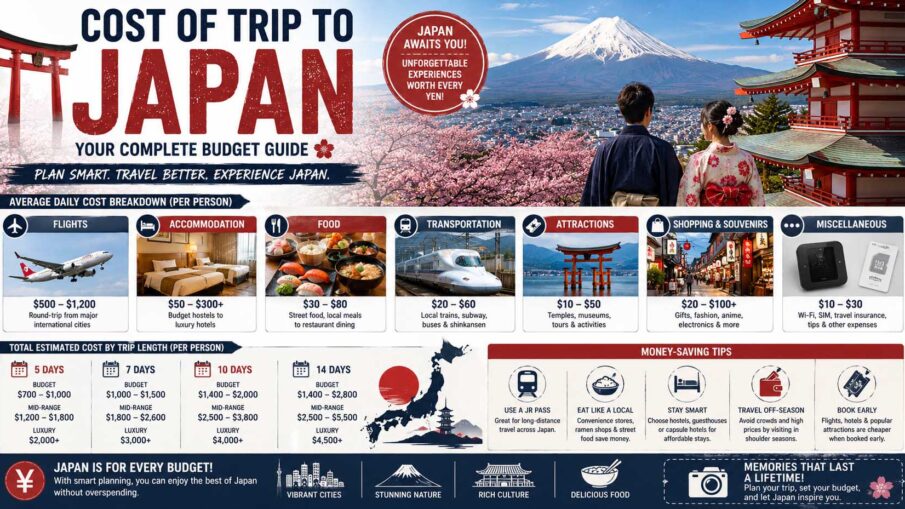
Planning a Japanese vacation often starts with one big question: what is the cost of trip to Japan? For most travelers, the answer depends heavily on airfare, trip length, accommodation style, transportation choices, and how often they eat at expensive restaurants. Japan can certainly be a premium destination, but it can also be surprisingly manageable when you plan ahead and spend selectively.
As a practical starting point, a one-week Japan trip can range from roughly $1,500 to $4,000+ per person including international flights. However, travelers using hostels, business hotels, convenience-store meals, and limited long-distance travel may spend less. Meanwhile, luxury hotels, fine dining, private experiences, and frequent bullet-train journeys can push the total much higher.
The best approach, therefore, is to break the budget into individual categories instead of relying on one average figure.
Average Cost of a Trip to Japan at a Glance
The average cost of a trip to Japan varies so widely because two travelers can visit the same cities while spending completely different amounts.
Here is a useful planning estimate for a seven-day trip:
| Travel Style | Estimated Daily Cost* | Estimated 7-Day Cost* |
|---|---|---|
| Budget | $70–$120 | $490–$840 |
| Mid-range | $130–$250 | $910–$1,750 |
| Comfortable | $250–$400 | $1,750–$2,800 |
| Luxury | $400+ | $2,800+ |
*These figures are broad planning estimates per person and generally exclude international airfare.
Consequently, your departure country can make a major difference. A traveler flying from another Asian destination may pay far less for airfare than someone traveling from North America or Europe.
Your itinerary matters as well. For example, staying mainly in Tokyo costs differently from traveling between Tokyo, Kyoto, Osaka, Hiroshima, and other regions.
What Determines the Cost of Trip to Japan?
Several expenses shape your final budget, yet accommodation, airfare, and transportation usually account for the largest share.
International Flights
Airfare is one of the least predictable expenses. Prices change according to your departure airport, airline, booking date, season, route, and baggage allowance.
Travel during popular periods, such as cherry blossom season and major holidays, can bring higher prices. By contrast, less popular travel periods may offer better airfare and accommodation deals.
Therefore, flexible travelers should compare several departure dates rather than choosing flights based on a single weekend. It also helps to understand the best time to travel to japan before booking, since seasonal demand can affect much more than airfare.
Accommodation
Japan provides accommodation for almost every budget. Hostels and simple guesthouses suit travelers who mainly need a clean place to sleep. Meanwhile, business hotels often provide compact private rooms in convenient urban locations.
Mid-range hotels generally offer more space and amenities, while ryokan stays can become a memorable part of the trip. However, traditional inns that include elaborate meals or private baths may cost considerably more.
As a rough guide, budget accommodation may start around $25–$60 per person per night, while standard hotel rooms commonly cost $70–$180 or more. In Tokyo, Kyoto, and other popular destinations, rates can climb substantially during busy dates.
Booking early usually gives you a wider choice of properties and locations.
Food Costs: Eating Well Without Overspending
Japanese food is one reason many travelers want to visit, yet eating well does not require an enormous budget.
Convenience stores, bakeries, supermarkets, noodle shops, curry restaurants, and casual chains provide inexpensive meals. Therefore, budget travelers can often keep daily food spending around $20–$40.
A mid-range traveler who mixes casual lunches with restaurant dinners might spend around $40–$80 per day. On the other hand, sushi counters, premium wagyu restaurants, tasting menus, and high-end dining experiences can quickly raise the total.
One useful strategy is to spend selectively. For example, enjoy inexpensive ramen at lunch, then allocate more money for one memorable dinner.
Also, hotels that include breakfast may reduce your morning spending. Still, compare the room price because an included meal is not always cheaper than eating nearby.
Transportation Costs Around Japan
Japan’s public transportation system makes independent travel relatively straightforward. Still, transportation costs depend heavily on how far you travel.
Within cities, trains, subways, and buses are usually the most practical options. Consequently, travelers exploring one city may spend only a modest amount each day on local transportation.
Long-distance travel changes the equation. Shinkansen bullet-train tickets between major cities can become a significant part of the budget, particularly when your itinerary includes several regions.
Therefore, calculate major intercity journeys individually before automatically buying a rail pass. Depending on your route, individual tickets or regional passes may offer better value.
Walking also saves money while allowing you to experience neighborhoods you might otherwise miss.
How Trip Length Changes Your Japan Budget
Naturally, a longer vacation costs more overall. However, the daily average does not always increase at the same rate.
For instance, airfare remains roughly the same whether you stay seven days or ten. As a result, adding a few extra days may provide better value than taking a very short trip, especially after paying for a long international flight.
Before setting your budget, decide how much of the country you realistically want to experience. Travelers concentrating on the capital can use a guide to how many days in tokyo to avoid paying for extra nights without a clear sightseeing plan.
A seven-day itinerary might focus on Tokyo and Kyoto, while a 10- to 14-day trip gives you more room for Osaka, Hiroshima, Nara, Hakone, or smaller destinations.
Cheapest Time to Visit Japan
Travel dates can have a noticeable effect on the cost of a trip to Japan.
Spring attracts large numbers of visitors because of cherry blossoms, while autumn is popular for comfortable temperatures and colorful foliage. Consequently, hotels in sought-after destinations may become more expensive during peak periods.
Summer can bring heat and humidity, although conditions vary across Japan. Winter, meanwhile, can offer good value in some cities, while ski destinations experience their own high season.
January after the New Year holiday, parts of February, and some less-demanded periods can sometimes offer attractive pricing. However, there is no single cheapest month every year because airfare and hotel demand constantly change.
Travelers comparing seasons should research the best month to visit japan alongside current flight and hotel prices. That approach gives you a better balance between weather, crowds, activities, and cost.
Seasonal Experiences Worth Budgeting For
Your travel season affects more than accommodation prices. It also determines which experiences are available.
Spring brings cherry blossoms, parks, seasonal food, and popular outdoor sightseeing. However, demand can make spontaneous accommodation harder to find.
Summer offers festivals, mountain activities, and long sightseeing days, though high temperatures can make urban exploration tiring.
Autumn combines pleasant sightseeing weather with spectacular foliage. Travelers visiting during this period may want to research the best places to see autumn leaves japan before finalizing accommodation because popular foliage destinations can fill quickly.
Winter, meanwhile, brings skiing, snow-covered landscapes, hot springs, and seasonal illuminations. Therefore, your ideal season should reflect what you actually want to experience rather than price alone.
Family of 4 Trip to Japan Cost
Calculating the family of 4 trip to Japan cost requires a slightly different approach because some expenses multiply while others can be shared.
For a seven-day vacation, a family might reasonably budget around $5,000–$10,000+ including international airfare, depending heavily on departure point, accommodation, attractions, and travel style.
Hotel rooms can be one challenge because many Japanese rooms are compact. Therefore, families should check maximum occupancy carefully rather than assuming one standard room accommodates four people.
Transportation also adds up quickly when several family members need individual tickets. However, younger children may qualify for reduced fares depending on the service and age.
Family-friendly attractions can increase daily spending too. Theme parks, observation decks, museums, aquariums, and special experiences should therefore receive their own budget category.
Budget for Attractions and Things to Do
Fortunately, many memorable Japanese experiences cost little or nothing.
Shrines, neighborhoods, parks, markets, shopping districts, scenic walks, and observation areas can fill much of your itinerary without a large admission budget.
Meanwhile, museums, gardens, castles, theme parks, guided tours, and cultural experiences generally require tickets.
A reasonable sightseeing allowance might be around $10–$30 per person per day for a moderate itinerary. However, a theme-park day or premium tour can cost considerably more.
Therefore, list your must-do paid attractions before departure. Once those are covered, you can build free activities around them.
Hidden Expenses Travelers Sometimes Forget
Small costs can gradually increase the average cost of trip to Japan, especially when they are missing from the original budget.
Shopping deserves its own allowance as well. Japan offers everything from electronics and cosmetics to anime merchandise, traditional crafts, stationery, and regional foods. Consequently, travelers who enjoy shopping should create a separate spending limit rather than borrowing from their food or transportation budget.
Mobile internet should also be planned before arrival. An eSIM, SIM card, or pocket Wi-Fi can make navigation and translation much easier.
How to Lower the Cost of a Trip to Japan
You do not need to sacrifice the best parts of Japan simply to save money. Instead, focus on expenses that provide little extra value.
First, compare flights using flexible dates. Then, reserve accommodation early if you are visiting during a busy season.
Next, stay close to useful train or subway lines. A cheaper hotel far outside the center can become less appealing once you add transportation costs and lost sightseeing time.
Also, mix paid attractions with free neighborhoods, shrines, parks, and viewpoints. Likewise, use casual restaurants for most meals while budgeting for a few special dining experiences.
When preparing your luggage, learning how to pack a suitcase efficiently can also help you avoid unnecessary baggage fees and make train travel much easier.
Finally, avoid changing cities every night. A slower itinerary reduces transportation expenses while giving you more time to enjoy each destination.
Sample 10-Day Japan Budget
Suppose one traveler plans a comfortable 10-day journey covering Tokyo, Kyoto, and Osaka.
A possible budget might look like this:
| Expense | Estimated Cost |
| Round-trip international flight | $700–$1,500 |
| Accommodation | $700–$1,500 |
| Food | $350–$700 |
| Local and intercity transportation | $250–$500 |
| Attractions and activities | $150–$350 |
| Internet, insurance and miscellaneous | $150–$300 |
| Estimated Total | $2,300–$4,850 |
These numbers are planning ranges rather than fixed prices. Exchange rates, departure location, season, booking timing, and personal preferences can all change the total.
Common Budgeting Mistakes to Avoid
One common mistake is budgeting for flights and hotels while overlooking daily spending. Food, subway rides, admission tickets, coffee, snacks, and shopping can quietly add hundreds of dollars.
Another mistake is assuming every rail pass automatically saves money. Instead, compare the cost of your actual journeys before buying one.
Travelers also sometimes choose the cheapest accommodation without checking its location. However, staying far from the places you want to visit can cost both time and money.
Finally, avoid scheduling too many cities. Japan rewards slower travel, and fewer hotel changes usually mean a simpler and less expensive trip.
FAQs About Japan Trip Costs
How much money do I need for a week in Japan?
Excluding international flights, a budget traveler might spend roughly $500–$850 for seven days, while a mid-range traveler may spend around $900–$1,750. Comfortable and luxury trips can cost considerably more.
Is Japan expensive for tourists?
Public transportation, casual restaurants, convenience stores, business hotels, and many free attractions make it possible to control daily expenses.
What is the average cost of a trip to Japan for two people?
A couple might spend roughly $3,000–$7,000+ for a one-week trip including flights, depending on their departure city and travel style. Sharing a hotel room can reduce the per-person accommodation cost.
How much cash should I take to Japan?
Rather than carrying your entire travel budget in cash, keep enough yen for smaller businesses, local purchases, and places where cards may be inconvenient. Cards are widely useful in many tourist areas, while ATMs can provide extra cash when needed.
Is two weeks in Japan much more expensive than one week?
The total will certainly be higher, but airfare remains largely unchanged. Therefore, the average cost per day can become more reasonable on a longer trip. Accommodation, food, local transportation, and attractions will account for most of the extra spending.
Planning a Japan Trip That Fits Your Budget
The cost of trip to Japan is flexible enough to suit very different travelers. A careful budget traveler can explore Japan without spending heavily every day, while travelers seeking premium hotels, fine dining, and private experiences can easily build a luxury vacation.
Most of all, leave some breathing room in your budget. Japan is full of unexpected food, neighborhoods, shops, and experiences that may catch your attention once you arrive. A small flexible allowance lets you enjoy those moments without worrying about every yen.