
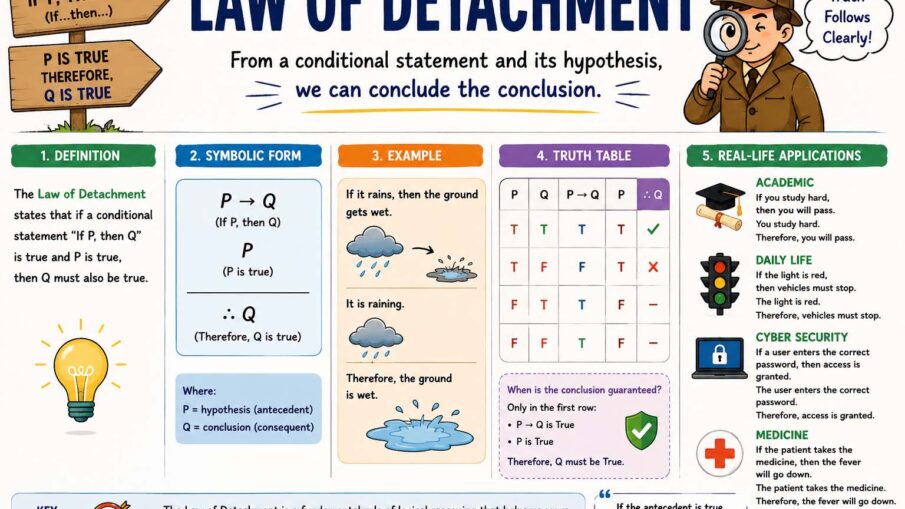
The law of detachment can refer to a formal rule of logical reasoning as well as a broader idea of letting go of rigid expectations. In logic, it describes a valid inference: if a conditional statement is true and its condition is true, its conclusion follows. In everyday mindset discussions, people often use “detachment” more loosely to describe focusing on what they can control without becoming overly attached to a specific outcome.
For travelers, that second idea can be useful. A trip may involve delayed transportation, changing weather, closed attractions, crowded destinations, or unexpected schedule changes. Therefore, keeping plans flexible can make it easier to respond calmly when reality differs from the original itinerary.
What Is the Law of Detachment?
In formal logic, the law of detachment follows a simple pattern:
- If P, then Q
- P is true
- Therefore, Q is true
This form of reasoning is commonly known as modus ponens. The OpenStax explanation of rules of inference covers this type of valid logical argument.
For example:
- If a flight is canceled, the traveler must change the original travel plan.
- The flight is canceled.
- Therefore, the traveler must change the original travel plan.
However, the phrase also appears in personal-development discussions with a different meaning. In that context, detachment generally refers to releasing excessive attachment to a particular outcome while continuing to make sensible decisions.
These meanings should not be confused. One is a formal rule of logic, while the other is a broader mindset concept.
Law of Detachment in Travel
Travelers cannot control every part of a journey. For example, weather can change quickly, airlines can alter schedules, and popular attractions may become unexpectedly busy.
Therefore, a flexible traveler prepares carefully but also accepts that some plans may change.
This approach does not mean ignoring reservations, safety, budgets, or schedules. Instead, it means separating good preparation from the expectation that everything must happen exactly as planned.
As a result, a traveler can focus on solving a problem rather than becoming stuck on the original plan.
Benefits of the Law of Detachment for Travelers
A rigid itinerary can become difficult to maintain when unexpected events occur. On the other hand, leaving some flexibility creates room for alternatives.
For example, flexible travelers may:
- Adjust activities when weather changes
- Move an attraction to another day
- Choose an alternative transportation option
- Explore somewhere unexpected
- Change meal plans when restaurants are busy
- Allow extra time between important bookings
Therefore, flexibility can complement careful travel planning rather than replace it.
Law of Detachment Examples for Travelers
The concept becomes easier to understand through practical examples.
Example 1: Detachment During Bad Weather
Suppose you planned an outdoor sightseeing day, but heavy rain begins in the morning.
Instead of treating the day as ruined, you could move outdoor activities to another day and visit museums, cafés, markets, or indoor attractions.
Therefore, the goal remains enjoying the destination even though the original plan changes.
Example 2: Flexible Thinking During a Transportation Delay
Imagine that a train delay causes you to miss a planned attraction.
A rigid response focuses entirely on the lost plan. In contrast, a flexible response looks for another useful activity nearby or reschedules the attraction.
As a result, one delay does not need to define the entire day.
Example 3: Detachment From a Fixed Itinerary
A famous attraction may be far busier than expected.
Instead of spending hours waiting, you might visit a nearby alternative and return at a quieter time. Therefore, flexibility can protect both your schedule and your enjoyment.
Destinations for Practicing Flexible Travel
No destination automatically creates detachment or mindfulness. However, some types of trips make slower and more flexible travel easier.
Bali and Flexible Travel
Bali offers beaches, cultural attractions, cafés, temples, and inland areas that support varied itineraries.
For example, if rain affects a beach day, travelers can consider indoor activities or change the order of their plans. Therefore, building alternatives into the itinerary can make weather changes easier to manage.
Kyoto and a Flexible Itinerary
Kyoto offers temples, gardens, historic districts, museums, food experiences, and seasonal scenery.
However, popular areas can become busy. Therefore, travelers may benefit from flexible timing and alternative attractions rather than expecting every famous location to be quiet.
Iceland and Changing Conditions
Weather can strongly affect outdoor travel in Iceland. As a result, visitors should monitor conditions and remain prepared to adjust driving routes or activities when necessary.
In this case, flexibility is not simply a mindset. It can also form part of responsible trip planning.
Law of Detachment and the Best Time to Travel
The best travel period depends on the destination, weather, personal preferences, and activities. However, travelers who dislike heavy crowds may consider shoulder or off-peak periods where appropriate.
Spring Travel
Spring can offer pleasant conditions in many destinations. However, weather and visitor levels vary significantly by region.
Therefore, travelers should research the specific destination instead of assuming spring always provides mild weather or smaller crowds.
Summer Travel
Summer is a popular travel season in many regions. As a result, famous attractions can become busy and accommodation demand may increase.
Flexible travelers can respond by visiting less crowded areas or changing the time of day they explore major attractions.
Autumn Travel
Autumn can suit travelers who enjoy cooler temperatures and seasonal scenery in certain destinations.
However, conditions vary widely. Therefore, destination-specific weather research remains necessary.
Winter Travel
Winter can provide snow activities, seasonal events, or quieter experiences depending on the location. Travelers deciding where to travel in winter can compare destinations according to climate, activities, and personal preferences.
Law of Detachment and Flexible Travel Planning
Detachment from one exact date, hotel, or destination can sometimes create more options for budget-conscious travelers.
However, flexibility does not guarantee cheaper prices. Airfares and accommodation rates depend on demand, route, destination, booking conditions, events, and many other factors.
Compare Different Travel Dates
First, compare several departure and return dates when your schedule allows it.
For example, moving a trip by a day or two may reveal different fares. Nevertheless, travelers should compare the total trip cost rather than looking only at the flight price.
Consider Shoulder and Off-Peak Periods
Next, check whether your destination has lower-demand travel periods.
These periods may offer different prices or crowd levels. However, some attractions, transportation services, or seasonal businesses may operate reduced schedules.
Therefore, always compare savings with the experience you actually want.
Law of Detachment and Weather Changes
Weather is one of the clearest reasons to avoid becoming attached to a perfect itinerary.
Tropical Destinations
Tropical destinations may experience rain even during popular travel periods. Therefore, travelers can prepare indoor alternatives instead of assuming every day will provide ideal beach conditions.
Cold Destinations
Cold-weather trips require suitable clothing and attention to forecasts.
For instance, snow, wind, or ice may affect roads and outdoor activities. As a result, travelers should prioritize safety over maintaining an original schedule.
Hot and Desert Destinations
Hot climates can make outdoor sightseeing uncomfortable during the hottest parts of the day.
Therefore, travelers can schedule outdoor activities for more suitable times and keep indoor alternatives available.
Travel Planning With the Law of Detachment
A flexible mindset works best when combined with sensible preparation.
Avoid Overplanning Every Hour
First, identify the activities that genuinely require reservations or fixed times.
Then, leave some open periods around them. As a result, delays or spontaneous discoveries become easier to accommodate.
Travelers looking for fresh ideas may also explore where to find inspiration.
Prepare Alternative Travel Plans
Instead of creating only one plan, keep a few backup options.
For example, prepare one outdoor activity and one indoor alternative for a day with uncertain weather. Therefore, a forecast change does not require rebuilding the entire itinerary.
Focus on the Travel Experience
Social media can create unrealistic expectations about destinations. However, a real trip includes crowds, weather changes, queues, construction, and ordinary moments.
Understanding normative social influence can also help travelers recognize how other people’s behavior and expectations may affect their own choices.
Common Law of Detachment Travel Mistakes
Detachment should not become an excuse for poor preparation.
Avoid Confusing Detachment With No Planning
Travelers still need to research entry requirements, transportation, accommodation, safety, and other essential details.
Therefore, flexibility works best after the necessary planning has been completed.
Avoid Comparing Every Trip Online
Another person’s carefully selected travel photos do not show every delay, queue, expense, or disappointing moment.
Instead, evaluate your trip according to your own priorities and experiences.
Avoid Overreacting to Minor Changes
A small schedule change does not necessarily ruin a trip.
Instead, identify what you can control and choose the best available alternative. This response can make practical problem-solving easier.
Law of Detachment in Geometry and Logic
The phrase “law of detachment geometry” usually refers to logical reasoning used in mathematical arguments.
The structure is:
If P, then Q.
P is true.
Therefore, Q is true.
For example:
- If a figure is a square, then it has four sides.
- Figure A is a square.
- Therefore, Figure A has four sides.
This conclusion follows logically from the two premises.
Therefore, the mathematical meaning of detachment is different from the personal-development use of the term.
Law of Detachment in Math: A Travel Example
The same logical structure can also illustrate a simple travel decision.
Suppose:
- If severe weather closes a hiking trail, the hike cannot proceed.
- Severe weather has closed the trail.
- Therefore, the hike cannot proceed.
The conclusion follows from the stated premises.
However, the rule does not tell the traveler what alternative activity to choose. That decision requires additional information and judgment.
Travelers asking what is the safest way to travel can similarly compare relevant conditions instead of relying on a single assumption.
Law of Detachment for Long-Term Travel
Long-term travelers often deal with changing accommodation, transportation, schedules, and working conditions.
Therefore, adaptability can become a practical skill.
For example, a remote worker may need a backup workspace if an internet connection fails. Likewise, someone staying in a destination for several weeks may change activities according to weather or local events.
However, long-term flexibility should still operate within visa rules, local laws, budgets, insurance requirements, and other practical constraints.
Flexible Thinking for Solo Travelers
Solo travelers make many decisions without a companion. Therefore, having alternative plans can be especially useful when circumstances change.
For example, a solo traveler can:
- Keep backup transportation options
- Save alternative indoor activities
- Leave extra time around important connections
- Adjust an itinerary when conditions change
- Choose activities based on personal comfort
However, flexibility should never override safety. If conditions become unsafe, travelers should follow official advice and change their plans accordingly.
Law of Detachment vs. Giving Up Control
Detachment does not mean becoming passive.
Instead, a useful distinction is between controlling your preparation and trying to control every outcome.
You can choose your accommodation, research transportation, monitor weather, create a budget, and prepare backup plans. However, you cannot guarantee that a flight will depart exactly on time or that every attraction will match your expectations.
Therefore, flexible travel combines preparation with acceptance of uncertainty.
FAQ About the Law of Detachment
What Is the Law of Detachment?
In formal logic, it is a valid inference in which “if P, then Q” and “P” allow you to conclude “Q.” In broader mindset discussions, detachment often refers to releasing excessive attachment to a specific outcome.
How Can the Law of Detachment Apply to Travel?
Travelers can prepare carefully while accepting that weather, transportation, crowds, and other circumstances may change. Therefore, they can adjust plans without treating every change as a failed trip.
Does Detachment Mean You Should Not Plan?
No. Planning remains essential for travel. Instead, detachment means avoiding unnecessary attachment to every detail happening exactly as expected.
Is the Law of Detachment Used in Geometry?
Yes. Geometry and other areas of mathematics use logical inference. If a conditional statement and its hypothesis are true, the corresponding conclusion follows.
Can Flexible Thinking Reduce Travel Stress?
Flexibility can make unexpected changes easier to manage because travelers already accept that alternative plans may become necessary. However, it does not eliminate every source of travel stress.
Is Off-Season Travel Always Better?
No. Off-season travel can have advantages, but weather, reduced services, attraction closures, or other factors may affect the experience. Therefore, travelers should research the specific destination before deciding.
Conclusion: Applying the Law of Detachment
The law of detachment has two different uses that travelers should distinguish. In formal logic, it describes a valid form of reasoning. In everyday mindset discussions, detachment refers more broadly to releasing rigid expectations while continuing to make thoughtful choices.
For travel, the practical lesson is simple: prepare well, but remain flexible. Flights may change, weather may interfere with activities, and destinations may look different from online expectations.
Therefore, travelers can benefit from focusing on the decisions they control while adapting to circumstances they cannot control. With good preparation and realistic expectations, unexpected changes can become manageable parts of the journey rather than reasons to consider the entire trip a failure.