
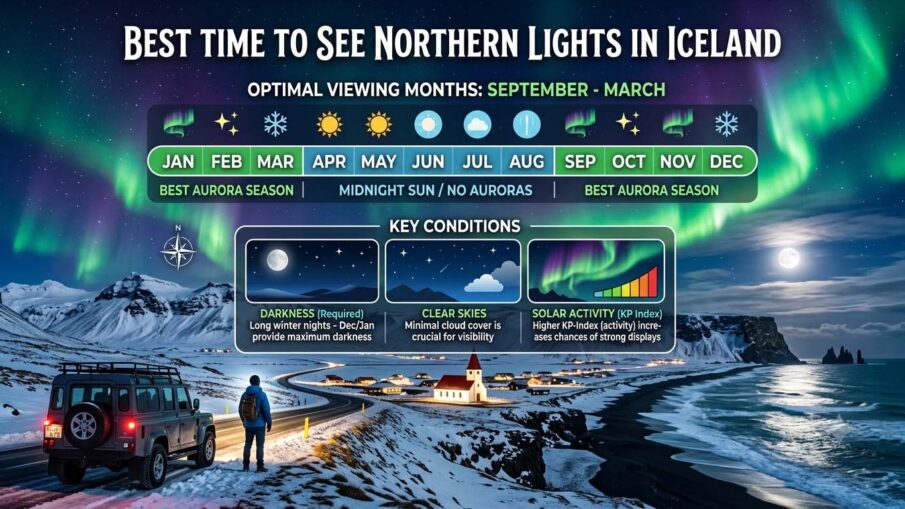
The best time to see northern lights in Iceland is generally from late September through early April, when the country experiences long, dark nights. However, successful aurora viewing depends on more than the season. Clear skies, solar activity, and your viewing location also play important roles.
Iceland is one of the world’s most memorable destinations for watching the aurora borealis. Its dramatic landscapes, remote countryside, and accessible viewing locations make it especially attractive to travelers.
For example, you might see green lights dancing above snow-covered mountains, glaciers, or volcanic landscapes. Nevertheless, sightings are never guaranteed, even during peak winter.
Therefore, planning your visit carefully can improve your chances of experiencing this remarkable natural phenomenon.
This guide explains the best months to visit Iceland, ideal viewing conditions, recommended locations, seasonal travel considerations, and practical aurora-hunting tips.
Travelers comparing the best places to see northern lights often choose Iceland because of its distinctive scenery and accessible viewing areas.
Best Time to See Northern Lights in Iceland
The main aurora-viewing season generally extends from September into early April. However, darkness and cloud cover vary throughout these months.
| Month | Darkness for Viewing | Daylight Conditions | Travel Considerations |
|---|---|---|---|
| September | Good, especially late month | Moderate daylight | Milder temperatures |
| October | Very good | Shortening days | Autumn conditions |
| November | Excellent | Short days | Increasing winter weather |
| December | Excellent | Very short days | Holiday travel demand |
| January | Excellent | Very short days | Cold, unpredictable weather |
| February | Excellent | Increasing daylight | Winter activities |
| March | Very good | Longer sightseeing hours | Winter conditions remain possible |
| April | Limited, mainly early month | Rapidly lengthening days | Shorter viewing window |
These descriptions reflect available darkness, not guaranteed aurora activity.
In fact, a clear October night may provide a better viewing opportunity than a cloudy night in December.
Therefore, checking the weather forecast is just as important as choosing the right month.
Why Iceland Is Ideal for Aurora Viewing
Iceland lies beneath a region where auroral displays frequently occur.
As a result, the country offers favorable geographic conditions for observing the northern lights.
Several features make Iceland particularly attractive:
- Long winter nights
- Dark countryside away from city lights
- Dramatic mountains and coastal scenery
- Accessible viewing areas near Reykjavík
- Guided aurora excursions
- Opportunities to combine sightseeing with nighttime viewing
In addition, visitors can explore waterfalls, glaciers, hot springs, and volcanic landscapes during the same vacation.
However, Iceland’s rapidly changing weather can interrupt outdoor plans.
Therefore, travelers researching the best time to go to Iceland should consider both aurora viewing and their preferred daytime activities.
Northern Lights in Iceland by Season
Two conditions matter most when planning an aurora-viewing trip: sufficient darkness and clear skies.
Although auroral activity occurs throughout the year, Iceland’s bright summer nights make sightings difficult or impossible.
Therefore, autumn, winter, and early spring provide the most practical opportunities.
Autumn: September to November
Autumn offers a useful balance between darkness and daytime sightseeing.
September generally has milder temperatures, while October brings increasingly long nights.
By November, winter weather becomes more common.
However, autumn storms can still create cloudy conditions.
Best for: Travelers who want to combine aurora viewing with scenic road trips and outdoor attractions.
Winter: December to February
Winter provides the longest nights of the year.
Consequently, visitors have extended periods of darkness when auroras may become visible.
December and January offer particularly short daylight hours. Meanwhile, February gradually brings more time for daytime activities.
However, snowstorms, icy roads, and heavy cloud cover can disrupt travel.
Best for: Travelers interested in snowy landscapes, winter excursions, and long nighttime viewing windows.
Early Spring: March to April
March offers a useful combination of dark evenings and increasing daylight.
As a result, travelers can spend more time sightseeing before searching for auroras at night.
Early April can also provide viewing opportunities.
However, the rapidly lengthening days reduce the available darkness.
Best for: Visitors who want winter scenery without the shortest daylight hours of midwinter.
Best Months for Northern Lights in Iceland
Each month offers different advantages.
Therefore, your ideal travel dates depend on whether you prioritize darkness, weather, or sightseeing.
September: Beginning of the Aurora Season
September marks the return of sufficiently dark nights.
Although early September has relatively limited darkness, viewing opportunities improve as the month progresses.
Advantages:
- Generally milder weather than midwinter
- Autumn landscapes
- More daylight for sightseeing
- Potentially easier driving conditions
For example, travelers can explore waterfalls during the day and search for auroras after sunset.
However, cloud cover can still prevent sightings.
October: Longer Nights and Autumn Scenery
October provides longer nights than September.
As a result, travelers gain more hours of potential aurora viewing.
Advantages:
- Increasing darkness
- Autumn scenery
- Opportunities for daytime sightseeing
- Less extreme daylight restrictions than midwinter
However, October weather can become windy and unpredictable.
Therefore, flexible travel plans remain essential.
November: Extended Darkness
November brings considerably shorter days.
Consequently, visitors have longer nighttime viewing windows.
Advantages:
- Long dark evenings
- Winter scenery in many regions
- Opportunities for seasonal excursions
However, snow, ice, and strong winds may affect roads.
Therefore, check driving conditions before traveling outside populated areas.
December: Long Winter Nights
December offers some of Iceland’s longest nights.
As a result, there are many hours when the sky is dark enough for aurora viewing.
Advantages:
- Extended darkness
- Winter landscapes
- Festive atmosphere
However, December’s short days limit sightseeing time.
In addition, holiday demand can increase accommodation costs.
January: Excellent Darkness
January continues to offer long nights and winter scenery.
Therefore, it remains a strong option for aurora-focused travel.
Advantages:
- Extended nighttime darkness
- Snow-covered landscapes
- Winter excursions
However, severe weather can make remote travel difficult.
For this reason, travelers should allow extra time for unexpected changes.
February: Winter Activities and Aurora Hunting
February combines long nights with gradually increasing daylight.
As a result, it offers opportunities for both daytime excursions and evening aurora searches.
Advantages:
- Good nighttime darkness
- Glacier activities
- Snowy landscapes
- More daylight than December
However, winter storms remain possible.
Therefore, avoid assuming that February always has better weather than January.
March: Darkness and Longer Days
March is a popular choice for travelers who want more daylight without giving up nighttime viewing opportunities.
For example, visitors can explore major attractions during the day and search for auroras after dark.
Advantages:
- Longer sightseeing hours
- Dark evenings
- Winter landscapes
- Opportunities for guided excursions
However, snow and icy roads can still affect travel.
Therefore, treat March as a winter travel month when planning transportation.
April: Final Opportunities of the Season
Early April can still provide dark enough skies for aurora viewing.
However, the viewing window becomes shorter as daylight increases.
By late April, the nights generally become too bright for reliable observation.
Therefore, travelers whose main goal is seeing the aurora should usually choose an earlier month.
Northern Lights in Iceland 2026: Best Travel Dates
For travelers planning a trip in 2026, the seasonal viewing pattern remains the same.
The main aurora season includes the early months of the year and returns in autumn.
Suitable travel periods include:
- January to March 2026
- Early April 2026
- Late September 2026
- October to December 2026
However, no specific date guarantees an aurora display.
For trips during the remaining months of 2026, late October through December offers increasing darkness.
Nevertheless, winter weather and holiday travel demand require careful planning.
Therefore, consider staying several nights rather than relying on a single evening.
Northern Lights in Iceland 2027: When to Visit
The 2027 viewing season also follows Iceland’s annual daylight cycle.
Good planning windows include:
- January to March 2027
- Early April 2027
- Late September 2027
- October to December 2027
For travelers who want a balance between sightseeing and aurora hunting, October and March may be appealing.
Meanwhile, December and January provide especially long nights.
However, longer darkness does not automatically mean better visibility.
Therefore, choose your travel dates according to your preferred activities and tolerance for winter weather.
Best Places to See Northern Lights in Iceland
Dark locations away from artificial lighting generally provide better viewing conditions.
However, clear skies and safe access matter more than choosing a famous photography spot.
Thingvellir National Park
Thingvellir National Park lies within reach of Reykjavík and offers scenic landscapes.
Because many areas have limited artificial lighting, it can be suitable for aurora viewing.
However, visitors should use designated parking areas and respect park restrictions.
Vík and Iceland’s South Coast
Vík is known for its dramatic coastline and black sand beaches.
As a result, the surrounding region attracts photographers seeking memorable landscapes.
However, the area’s powerful waves make beaches dangerous, especially after dark.
Therefore, choose safe inland viewpoints and avoid approaching the water.
Jökulsárlón Glacier Lagoon
Jökulsárlón offers dramatic scenery with floating icebergs.
On a clear night, auroral displays above the lagoon can create remarkable views.
However, travelers should stay on safe ground and never walk onto floating ice or unstable shorelines.
Snæfellsnes Peninsula
The Snæfellsnes Peninsula combines mountains, coastal scenery, and rural landscapes.
Therefore, it offers several potential aurora-viewing locations.
However, road conditions and cloud cover vary across the region.
Westfjords
The Westfjords contain remote landscapes with limited artificial lighting.
Consequently, they can offer dark skies.
However, winter travel can be difficult because of snow, road closures, and changing conditions.
Therefore, inexperienced winter drivers may prefer more accessible viewing areas.
These destinations may also interest travelers exploring where to travel in winter.
Weather Conditions for Viewing the Northern Lights
Even during peak season, cloud cover can hide an active aurora.
Therefore, checking forecasts before leaving your accommodation is essential.
Check the Cloud Cover
Clear skies provide the best opportunity to see auroral displays.
However, a forecast showing heavy cloud cover does not necessarily mean every nearby location will remain cloudy.
For example, conditions may differ between coastal and inland areas.
Monitor Aurora Activity
Aurora forecasts provide estimates of geomagnetic activity.
However, they cannot guarantee that a display will appear at a particular time or location.
For current conditions, consult the Icelandic Meteorological Office’s official aurora forecast.
The forecast combines information about cloud cover, darkness, and auroral activity.
Stay Flexible
Weather conditions can change quickly.
Therefore, avoid planning your entire vacation around one viewing location.
Instead, keep several evenings available and adjust your plans when conditions improve.
Travelers comparing Arctic destinations can also read our guide to the best time to see northern lights in Alaska.
How Many Nights Should You Stay for Aurora Viewing?
A single evening may provide a successful sighting.
However, relying on one night creates a greater risk of missing the aurora because of clouds or weak activity.
For this reason, a longer stay is usually preferable.
| Trip Length | Planning Consideration |
|---|---|
| 1 night | Only one opportunity |
| 2 nights | Limited flexibility |
| 3–4 nights | Several opportunities |
| 5–7 nights | More chances to wait for suitable conditions |
These categories describe planning flexibility rather than scientifically calculated sighting probabilities.
For example, a four-night trip gives you several chances to adjust your schedule if the first evening is cloudy.
Therefore, consider spending at least three or four nights in Iceland when aurora viewing is your main goal.
What to Pack for a Northern Lights Trip
Aurora viewing often requires standing outdoors for extended periods.
Therefore, warm and weather-resistant clothing is essential.
Pack:
- Thermal base layers
- Insulated jacket
- Waterproof outer layer
- Warm trousers
- Insulated waterproof boots
- Wool socks
- Gloves or mittens
- Warm hat
- Neck warmer
- Hand warmers
- Camera tripod
In addition, bring a fully charged phone and portable power bank.
Cold temperatures can reduce battery performance.
Therefore, keep spare batteries warm when possible.
Can You See Northern Lights in Iceland From Reykjavík?
Yes, auroras can sometimes appear above Reykjavík.
However, artificial lighting makes faint displays harder to see.
For better viewing conditions, consider:
- Visiting a darker location outside the city
- Joining a guided aurora tour
- Choosing accommodation away from bright streetlights
- Checking cloud cover before traveling
For example, a nearby rural viewpoint may offer darker skies than central Reykjavík.
Nevertheless, avoid stopping along unsafe roads or entering restricted areas.
Budget Tips for an Iceland Aurora Trip
Iceland can be an expensive destination.
However, thoughtful planning can help control travel costs.
Book Accommodation Early
Popular hotels and guesthouses may become expensive during busy periods.
Therefore, compare accommodation options well before your trip.
Travel Outside Major Holidays
Holiday periods can attract additional visitors.
As a result, flights and accommodation may cost more.
However, prices vary by date and availability.
Consider Guesthouses and Apartments
Guesthouses and self-catering accommodation can provide practical alternatives to hotels.
In addition, preparing some meals may reduce restaurant spending.
Compare Tours and Car Rentals
Guided tours can be useful for travelers unfamiliar with winter driving.
Meanwhile, rental cars offer greater flexibility in suitable conditions.
However, compare insurance coverage, fuel costs, road conditions, and tour cancellation policies before choosing.
Other Winter Activities in Iceland
Northern lights aren’t the only attraction during Iceland’s colder months.
Popular experiences include:
- Blue Lagoon visits
- Glacier hiking
- Guided ice cave tours
- Snowmobiling
- Whale watching
- Golden Circle sightseeing
- Waterfall visits
- Geothermal hot springs
For example, visitors can explore waterfalls during daylight and reserve the evening for aurora viewing.
However, some activities depend on weather and seasonal availability.
Therefore, confirm operating conditions before booking.
Common Mistakes When Chasing the Northern Lights
Avoiding a few common mistakes can make your trip more enjoyable.
Expecting the Aurora Every Night
Auroral displays depend on geomagnetic activity, darkness, and weather.
Therefore, even experienced guides cannot guarantee a sighting.
Instead, treat aurora viewing as an opportunity rather than a fixed appointment.
Staying Only One Night
One evening offers little flexibility if clouds cover the sky.
However, several nights allow you to wait for better conditions.
Therefore, build extra viewing opportunities into your itinerary.
Ignoring Weather Forecasts
A strong aurora forecast means little when thick clouds block the sky.
For this reason, review cloud forecasts alongside geomagnetic activity.
Dressing Too Lightly
Standing outdoors in cold and windy conditions can become uncomfortable quickly.
Therefore, wear multiple warm layers and protect exposed skin.
Driving in Unsafe Conditions
Winter storms can create hazardous roads and poor visibility.
Consequently, travelers should never chase the aurora at the expense of road safety.
If conditions deteriorate, remain somewhere safe and wait for another opportunity.
Northern Lights Photography Tips
Photographing the aurora requires preparation, especially in low light.
However, you don’t necessarily need expensive equipment to capture memorable images.
Use a Tripod
A tripod helps stabilize your camera during longer exposures.
As a result, photographs are less likely to show blur caused by movement.
Choose a Wide-Angle Lens
Wide-angle lenses capture more of the sky and surrounding landscape.
For example, you can include mountains or snowy scenery beneath the aurora.
Adjust Camera Settings
Try:
- Manual focus
- A wide aperture
- A moderate starting ISO
- A shutter speed suited to aurora movement
- RAW format when available
However, fast-moving auroras may require shorter exposures to preserve detail.
Therefore, experiment with settings instead of relying on one fixed combination.
Try Smartphone Night Mode
Modern smartphones can capture impressive nighttime images.
However, results depend on the phone’s camera capabilities and lighting conditions.
For better results, stabilize your phone and avoid unnecessary movement.
Frequently Asked Questions About Northern Lights in Iceland
What Is the Best Month to See the Northern Lights?
October, February, and March can offer a useful balance between darkness and sightseeing opportunities.
However, no month guarantees clear skies or strong aurora activity.
Can You See the Northern Lights Every Night?
No. Visibility depends on geomagnetic activity, cloud cover, and darkness.
Therefore, even during winter, some nights provide no visible display.
Is September Too Early for Northern Lights?
No. Viewing opportunities return as Iceland’s nights become darker.
However, late September generally provides longer viewing windows than early September.
Are Guided Northern Lights Tours Worth It?
Guided tours can be useful, especially for travelers unfamiliar with local weather and winter roads.
In addition, guides may adjust viewing locations according to forecast conditions.
However, no tour can guarantee a sighting.
Can Children Enjoy an Aurora Trip?
Yes. Families can combine aurora viewing with waterfalls, hot springs, and suitable winter activities.
However, late-night outings and cold temperatures may be challenging for younger children.
Therefore, plan warm clothing, rest breaks, and flexible schedules.
Is Iceland Better Than Alaska for Aurora Viewing?
Both destinations can provide excellent opportunities.
However, their weather patterns, accessibility, and travel experiences differ.
Therefore, the better destination depends on your budget, available dates, and preferred activities.
Final Thoughts: Planning Your Iceland Northern Lights Adventure
The best time to see northern lights in Iceland is generally from late September through early April. October, February, and March can be particularly appealing for travelers who want a balance of darkness and daytime sightseeing.
However, the right month is only one part of successful aurora hunting.
Clear skies, suitable viewing locations, and flexible travel plans are equally valuable.
For example, staying several nights gives you more opportunities to wait for favorable conditions.
Whether you’re visiting in 2026 or planning a trip for 2027, check official forecasts, prepare for changing weather, and prioritize safe travel.
With thoughtful planning and a little luck, you may experience one of nature’s most memorable nighttime displays.