
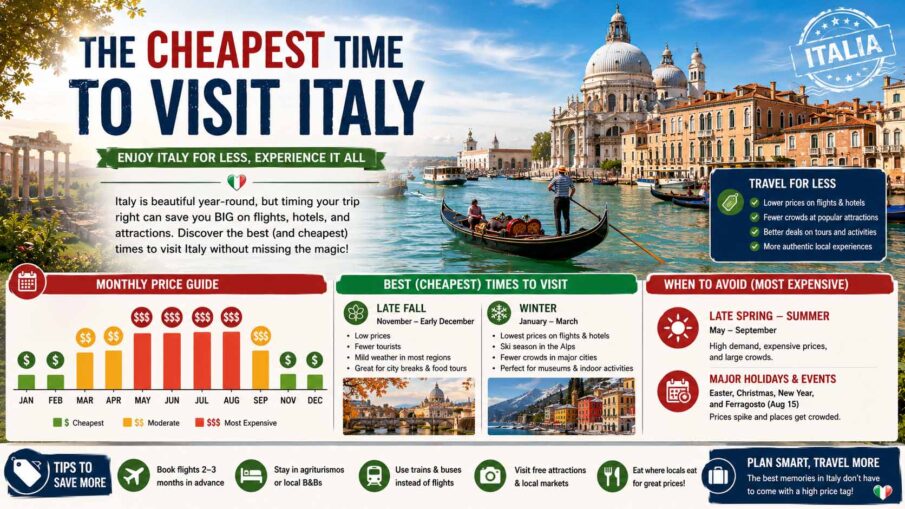
Italy doesn’t have to be an expensive vacation if you choose your dates carefully. For many travelers, the cheapest time to visit Italy falls during the quieter late-fall and winter periods, especially November and parts of January and February outside major holidays and special events. Airfare and accommodation can be more affordable than during summer, while famous cities often feel less crowded. However, prices vary sharply by destination, event calendar, departure city, and booking dates, so the lowest-cost month for Rome may not be the cheapest period for a ski trip or a warm coastal vacation.
The trade-off is weather. Winter brings shorter days, cooler temperatures, and reduced seasonal services in some resort areas. Still, travelers who prioritize museums, historic cities, food, and cultural attractions can find excellent value.
When Is the Cheapest Time to Visit Italy?
Generally, look at November and the post-holiday winter period from roughly mid-January through February if saving money is your main priority.
These months sit outside Italy’s busiest summer travel season. As a result, many destinations receive fewer international tourists, while accommodation demand can soften.
However, there are exceptions. Christmas and New Year can push prices higher, while February costs may rise in Venice around Carnival. Meanwhile, ski destinations in the Italian Alps and Dolomites can be busy during winter.
Therefore, think of Italy as several different travel markets rather than one destination with a single low season.
If you’re balancing weather, crowds, and price instead of chasing the absolute lowest cost, a broader guide to the best time to visit italy can help you compare the trade-offs between seasons.
Cheapest Time of Year to Visit Italy by Season
Italy stretches from the Alps to the Mediterranean, so conditions vary significantly. Nevertheless, this overview can help you narrow down your travel dates.
| Season | Typical Cost Level | Crowds | General Conditions | Budget Appeal |
|---|---|---|---|---|
| Winter | Low to moderate | Low outside holidays/events | Cool to cold; snow in mountains | Excellent for cities |
| Spring | Moderate to high | Increasing | Mild and pleasant | Good in early spring |
| Summer | High | Very high | Hot in many cities | Usually weakest for budgets |
| Fall | Moderate, then lower | Declining | Mild early, cooler later | Excellent in late fall |
Exact prices vary by destination and year. Therefore, always compare your specific flights and hotels before choosing dates.
Why November Can Be a Great Budget Month
November often deserves special attention from travelers seeking lower costs.
By then, the heavy summer rush has ended, while the Christmas travel period hasn’t fully started. Consequently, cities such as Rome, Florence, Bologna, Naples, and Turin can feel noticeably calmer.
Hotel prices may become more attractive, particularly on dates without major events. Meanwhile, museums and historic attractions remain available throughout the year.
Weather is the compromise. Rain becomes more likely in many areas, temperatures fall, and daylight hours shorten.
However, those conditions matter less when your itinerary focuses on churches, museums, cafés, restaurants, galleries, and historic neighborhoods.
For travelers comparing individual months, a guide to the best month to visit italy can also help determine whether the extra cost of better weather is worthwhile.
January and February: Low Prices With Some Exceptions
After the Christmas and New Year period, January can offer another strong window for budget travel.
Major sightseeing cities generally stay active year-round, yet tourist numbers can be much lower than in summer. Therefore, travelers may find better-value accommodation while enjoying shorter lines at some attractions.
February can also be affordable. However, check the event calendar carefully.
Venice is the clearest example. Carnival can create significant demand, so a month that’s inexpensive elsewhere in Italy may become costly in Venice during popular festival dates.
Likewise, mountain destinations follow a different seasonal pattern because winter is their primary tourism season.
Therefore, don’t book a “cheap winter trip” until you’ve checked what’s happening in your exact destination.
Cheapest Time to Visit Rome, Italy
For travelers specifically researching the cheapest time to visit Rome Italy, late November and parts of January and February can be worth checking.
Rome works particularly well as an off-season destination because its major appeal doesn’t depend on beach weather. The Colosseum, Pantheon, Vatican Museums, churches, piazzas, archaeological sites, restaurants, and neighborhoods remain central to the experience throughout the year.
Cooler weather can even make long sightseeing days more comfortable than the intense summer heat.
Still, Rome doesn’t become empty in winter. It remains one of Europe’s most popular cities, while holidays, religious events, weekends, and major happenings can increase demand.
Therefore, compare several dates rather than assuming every winter week costs the same.
Venice: Cheap Dates Require Careful Planning
Venice can be beautiful during the quieter season, particularly when streets and canals feel less overwhelmed by peak-season crowds.
Winter accommodation can sometimes cost considerably less than during popular spring and summer periods. Yet weather can be cold and damp, while high-water events can occasionally affect parts of the city.
Carnival is the bigger pricing consideration. Demand rises around the celebration, which can erase much of the usual winter savings.
If Venice is on your shortlist, researching is venice worth visiting can help you decide whether its unique atmosphere justifies fitting it into your budget and itinerary.
For the lowest prices, compare ordinary winter weekdays away from major events rather than selecting dates based solely on the month.
Milan Can Work Well for an Off-Season City Break
Milan has a different tourism pattern from Italy’s coastal resorts. Business travel, fashion events, football matches, exhibitions, and trade fairs can all influence room rates.
Consequently, winter isn’t automatically cheap every night.
However, flexible travelers can still find attractive off-season dates. Milan also makes a useful northern gateway because its rail connections allow easy onward travel to cities such as Turin, Bologna, Verona, and Venice.
Before building an itinerary around the city, consider is milan worth visiting based on your interests. Travelers who enjoy architecture, fashion, art, shopping, and urban food culture may find it worth several days, while others may prefer to use Milan mainly as an arrival point.
Naples Offers a Different Kind of Budget Italy Trip
Southern Italy can provide excellent value, especially for travelers who want food, history, and city life without focusing entirely on Italy’s most expensive tourist centers.
Naples has a lively historic center, famous pizza culture, archaeological attractions, and useful transport links for nearby destinations.
Winter weather is generally milder than in northern Italy, although rain and cool days are still possible.
Travelers deciding whether to include the city can first consider is naples worth visiting, particularly if Pompeii, Herculaneum, or other parts of Campania are already on the itinerary.
However, nearby coastal destinations such as Capri and the Amalfi Coast operate differently in winter. Some businesses reduce hours or close seasonally, so low prices may come with fewer services.
Cheapest Time to Visit Italy 2026: What Travelers Should Watch
For anyone planning the cheapest time to visit Italy 2026, flexibility remains more useful than selecting one supposedly perfect week.
Major events can temporarily increase prices even during otherwise affordable periods. Therefore, check city calendars before buying flights.
The 2026 Winter Olympics and Paralympics in Milan-Cortina are especially relevant to February and March 2026 travel in northern Italy. Olympic events run February 6–22, 2026, while the Paralympic Winter Games run March 6–15, 2026.
Consequently, travelers looking for low prices in Milan, Cortina d’Ampezzo, and other event areas should expect unusual demand around those dates.
Meanwhile, ordinary winter dates elsewhere in the country may follow very different pricing patterns.
For 2026 travel, search several combinations of destinations and dates rather than treating Italy as one market.
Shoulder Season vs Low Season: Which Offers Better Value?
The cheapest trip isn’t always the trip with the lowest hotel price.
March, April, October, and other shoulder-season periods can cost more than deep winter. However, travelers may gain longer daylight hours, milder temperatures, and more seasonal businesses operating normally.
As a result, shoulder season can sometimes provide better overall value.
For example, spending slightly more on a March hotel may make sense if pleasant weather lets you walk everywhere and enjoy more outdoor attractions.
Similarly, October can work well for travelers who want comfortable sightseeing temperatures without the strongest summer demand.
However, Easter periods and major events can increase prices sharply, so check your exact dates.
How Much Can Season Affect Your Italy Budget?
Your three biggest vacation expenses will often be flights, accommodation, and transportation.
Flights can fluctuate substantially according to departure airport, airline, baggage requirements, travel dates, and booking conditions. Therefore, compare total fares rather than the cheapest headline price.
Accommodation also varies enormously. A central hotel in Rome during a busy weekend can cost much more than the same property during a quiet winter weekday.
Meanwhile, train fares can sometimes be reduced by booking advance-purchase tickets on high-speed routes. However, cheaper fares may have stricter change or refund conditions.
Food costs are less season-dependent. Still, where you eat matters enormously.
A simple neighborhood restaurant, bakery, market, or takeaway meal can keep daily costs manageable, while restaurants immediately beside famous landmarks often charge more.
Saving Money on Flights to Italy
Start by searching a range of dates rather than one fixed departure.
Even shifting a trip by a few days can change airfare. Also, compare several Italian gateways if your itinerary allows it. Rome and Milan are obvious choices, yet another airport may occasionally produce a better combination of fare and onward transportation.
Next, calculate baggage fees. A low-cost fare stops being cheap when you add expensive checked luggage, seat selection, and airport transfers.
Also, compare round-trip tickets with open-jaw itineraries. For example, flying into Rome and home from Milan may prevent you from paying for a train back to your starting city.
Finally, don’t assume that booking extremely early or waiting for a last-minute deal guarantees the lowest fare. Instead, monitor realistic dates and buy when the total price works for your budget.
Accommodation Tricks That Make a Bigger Difference
Traveling during low season creates more room to compare accommodation.
First, check hotels a short walk or metro ride from the most famous areas. Staying directly beside the Trevi Fountain or Piazza San Marco isn’t necessary for a great trip.
Next, compare the full cost, including local taxes, breakfast, cleaning charges, and cancellation conditions.
Free cancellation can also be useful when planning far ahead. If prices later fall, your booking conditions may allow you to switch, although you should always check the property’s rules first.
For longer stays, apartments can sometimes offer value, especially when a kitchen helps reduce restaurant spending. However, compare service charges and location before assuming an apartment is cheaper.
Use Italy’s Trains to Build a Budget Itinerary
Italy’s rail network makes multi-city travel relatively straightforward.
A budget-friendly itinerary might combine Rome, Florence, and Bologna, while another could connect Milan, Verona, and Venice.
High-speed trains save time between major cities, while regional trains can be economical for shorter trips.
However, don’t add destinations simply because they’re accessible. Every city change may bring another train ticket, accommodation check-in, luggage transfer, and lost sightseeing time.
For a seven-day trip, two or three bases often provide a more relaxed experience than racing through five cities.
What to Pack for Cheap-Season Italy
Winter and late-fall packing should focus on layers.
Bring comfortable walking shoes, a weather-resistant outer layer, and clothing you can adapt to changing temperatures. Northern cities can feel quite cold in winter, while southern Italy may be milder.
A compact umbrella can also be useful during wetter periods.
Meanwhile, check your accommodation before packing bulky items such as hair dryers or extra towels. Traveling lighter may allow you to choose a cheaper airline baggage option.
Mistakes That Can Erase Your Savings
The biggest mistake is choosing a cheap flight without checking accommodation prices. A major event could make hotels unusually expensive on exactly those dates.
Likewise, don’t book an inexpensive coastal destination in deep winter without checking whether the restaurants, ferries, attractions, and hotels you want will actually be operating.
Another common mistake is overpacking the itinerary. Constant high-speed train travel can quickly increase your budget.
Finally, avoid focusing only on price. A €20 saving isn’t worthwhile if it creates a difficult airport transfer, extremely inconvenient arrival time, or accommodation far from everything you want to see.
FAQs About Visiting Italy on a Budget
What is the cheapest month to go to Italy?
November and parts of January and February are often among the more affordable periods, although prices vary by destination, event calendar, flights, and accommodation demand.
Is Italy cheaper in winter?
Many major Italian cities can be cheaper in winter than during summer. However, ski areas may be expensive, while Christmas, New Year, Carnival, and special events can increase prices.
Is November a good time to visit Italy?
Yes, especially for budget-focused city travel. You’ll generally encounter cooler, wetter weather and shorter days, yet major cultural attractions remain accessible and crowds can be lighter.
When is Italy most expensive?
Summer, particularly the busiest vacation periods, often brings high demand to major cities and coastal destinations. However, major festivals and events can create high prices at other times too.
When is the cheapest time to visit Italy for good weather?
Consider the edges of shoulder season if you want a compromise. Early spring or later fall may provide better weather than deep winter while remaining less expensive than peak summer, depending on your destination and dates.
Plan Around Value, Not Just the Lowest Price
The cheapest time of year to visit Italy is generally found during quieter late-fall and winter periods, with November and post-holiday January often worth checking first. February can also offer good deals, although Carnival, ski travel, and major 2026 events make destination-specific research essential.
Instead of choosing your trip from one cheap airfare, price the entire journey. Compare flights, accommodation, trains, airport transfers, attraction schedules, and seasonal closures together.
Then, give yourself some date flexibility. Italy changes dramatically between a quiet January morning in Rome, a February ski weekend in the Dolomites, and an August afternoon on the Amalfi Coast. Choosing the right low-season destination—not simply the cheapest month—can give you a more enjoyable trip while keeping your budget under control.