
Japan has a reputation for being pricey, but is Japan expensive to visit in reality? For many travelers, the answer is: not as expensive as expected. Hotels and long-distance trains can take a large part of your budget, yet everyday meals, public transportation within cities, and many sightseeing experiences can be surprisingly reasonable. With smart planning, Japan can work for budget travelers as well as visitors looking for a comfortable or luxury trip.
The biggest factor is how you travel. Someone staying in business hotels, eating at casual restaurants, and exploring one region will spend far less than a traveler choosing luxury ryokan stays, frequent Shinkansen trips, taxis, and high-end dining.
Is Japan Expensive to Visit in 2026?
Japan can be expensive, although it is not automatically a high-budget destination. Instead, costs vary dramatically according to your accommodation, itinerary, season, and transportation choices.
Tokyo and Kyoto usually require more careful budgeting because they attract huge numbers of visitors. Meanwhile, smaller cities can offer better-value accommodation and dining.
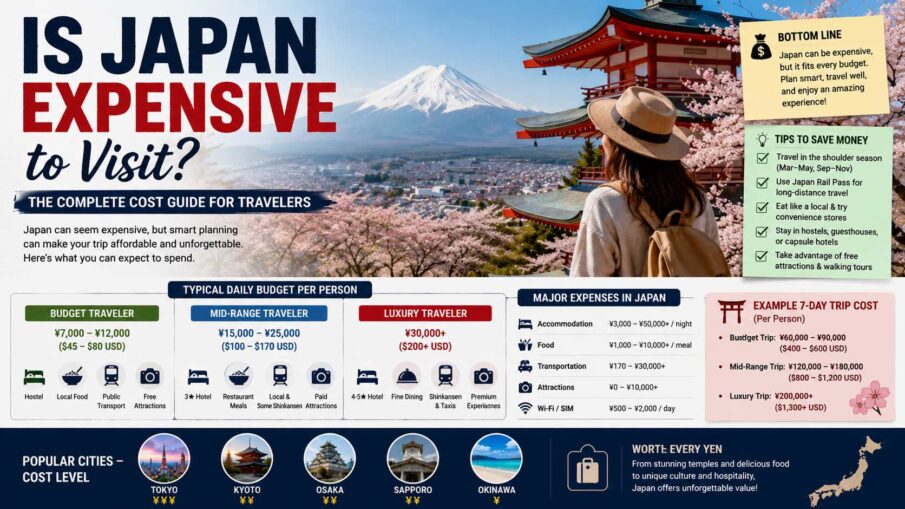
For a rough planning estimate, travelers might use these daily ranges, excluding international airfare:
| Travel Style | Approximate Daily Budget |
|---|---|
| Budget traveler | ¥8,000–¥15,000 |
| Mid-range traveler | ¥18,000–¥35,000 |
| Comfortable traveler | ¥35,000–¥60,000+ |
| Luxury traveler | ¥70,000+ |
These figures are only planning ranges. For instance, hotel rates can rise sharply during cherry blossom season, Japanese holidays, major events, and autumn foliage season.
Likewise, a traveler moving between Tokyo, Kyoto, Osaka, Hiroshima, and other cities will spend more on transportation than someone spending a week around Tokyo.
For a more complete estimate covering flights, hotels, food, transportation, and sightseeing, comparing the cost of trip to japan can help you build a realistic total budget before booking.
Accommodation Can Take a Large Share of Your Budget
Accommodation is one of the biggest variables in a Japanese vacation.
Hostels and capsule hotels can help solo travelers keep expenses down. Meanwhile, Japanese business hotels often provide compact but comfortable private rooms at reasonable rates outside peak periods.
At the other end of the scale, traditional ryokan stays can become expensive, particularly when the rate includes dinner and breakfast. However, they offer a cultural experience rather than simply a place to sleep.
Location matters as well. A hotel beside a major Tokyo station can cost considerably more than a similar property a few train stops away.
Therefore, check the neighborhood before paying extra for the most central location. Japan’s efficient rail systems often make slightly less central hotels perfectly practical.
Book Early for Popular Travel Seasons
Accommodation prices can increase when demand is strong. As a result, travelers visiting during cherry blossom season or popular autumn foliage weeks should book earlier than those traveling during quieter periods.
Japanese holiday periods can affect availability too. Golden Week, which falls around late April and early May, is particularly busy because many domestic travelers take trips at the same time.
New Year can also affect opening schedules, transport demand, and accommodation availability.
So, before choosing dates, research the best time to travel to japan based on both weather and expected crowds rather than looking at airfare alone.
Is Food Expensive in Japan?
Food is one area where Japan can pleasantly surprise visitors.
You certainly can spend heavily on sushi counters, wagyu restaurants, kaiseki dinners, and fashionable restaurants in Tokyo. However, you do not need premium dining every day to eat well.
Ramen, udon, soba, curry, rice bowls, set meals, bakeries, supermarkets, and convenience stores provide plenty of lower-cost choices.
Casual restaurants are especially useful for travelers who want a proper hot meal without paying fine-dining prices. Meanwhile, convenience stores can be handy for breakfast, snacks, drinks, and quick meals.
Supermarkets may offer another money-saving option. For instance, some stores discount prepared foods later in the day.
Therefore, mixing one memorable restaurant meal with simpler meals during the rest of the day can keep food spending under control without making your trip feel restrictive.
Transportation Can Change Your Entire Budget
Transportation deserves special attention because Japan’s rail network makes it tempting to visit many cities in one trip.
Local trains and subways are generally straightforward for daily sightseeing. However, repeated long-distance Shinkansen journeys can raise the overall cost significantly.
For example, a Tokyo-Kyoto-Osaka itinerary involves more intercity transportation than spending the same number of days exploring Tokyo and nearby destinations.
Therefore, build your itinerary geographically rather than adding cities simply because high-speed trains make them accessible.
Do You Need a Japan Rail Pass?
Do not automatically buy a nationwide Japan Rail Pass.
Following substantial price increases introduced in 2023, the pass no longer represents obvious savings for every tourist. Instead, calculate the cost of the individual train journeys you genuinely expect to take and compare that total with the relevant pass.
Regional rail passes may offer better value for some itineraries.
Meanwhile, highway buses and domestic flights can occasionally compete with rail prices on longer routes. However, convenience, luggage, airport transfers, and travel time should also influence your decision.
For current official travel information about transportation, destinations, practical planning, and entry guidance, travelers can consult the Japan National Tourism Organization’s official travel website.
Costs in Japan’s Major Tourist Cities
Your expenses can vary from city to city because accommodation demand, transportation needs, attractions, and dining options differ.
Tokyo
Tokyo can be expensive for accommodation, nightlife, premium shopping, and upscale restaurants. Yet the city also offers countless inexpensive restaurants, efficient public transportation, free neighborhoods to explore, parks, shrines, observation areas, and shopping districts where simply walking around is part of the experience.
If Tokyo is the main focus of your trip, deciding how many days in tokyo before booking hotels can prevent you from either rushing the city or paying for unnecessary extra nights.
Kyoto
Kyoto can become expensive during its busiest periods, especially when hotel demand surges.
However, travelers can enjoy many temples, shrines, traditional streets, and neighborhoods for free or for modest admission fees. Public buses and trains also make it possible to explore without relying heavily on taxis.
Osaka
Osaka often feels more relaxed for travelers watching their food budget. The city is famous for casual eating, while its compact tourist areas make exploring relatively straightforward.
Still, popular attractions and theme parks can raise your daily spending quickly.
Why Does Japan Have an Expensive Reputation?
People asking is Japan an expensive country to visit may remember Japan’s long-standing reputation as one of Asia’s costly destinations.
However, that reputation does not apply equally to every part of a modern vacation.
Some experiences remain costly. Luxury hotels, traditional ryokan, premium restaurants, taxis, theme parks, long-distance trains, and high-end shopping can all add up.
At the same time, Japan has an enormous everyday economy built for local residents. Therefore, travelers have access to casual restaurants, supermarkets, convenience stores, local trains, affordable chain restaurants, and reasonably priced everyday services.
The key is traveling more like a regular customer and less like a luxury tourist.
When Is Japan Cheapest to Visit?
There is no single cheapest month every year because flight and hotel prices respond to demand. Still, traveling outside the most popular holiday and sightseeing periods can improve your chances of finding better rates.
Winter after the New Year holiday can offer value in some cities, although ski destinations may be expensive.
Early summer can sometimes provide lower accommodation rates, although Japan’s rainy season may affect sightseeing plans.
Late autumn and early winter can also work well after peak foliage demand has passed in some regions.
Meanwhile, spring cherry blossom season is exceptionally popular.
If your dates are flexible, research the best month to visit japan according to the particular regions you want to see. Japan stretches a long way from Hokkaido to Okinawa, so weather and seasonal timing differ substantially across the country.
Autumn Travel: Scenery, Crowds, and Cost
Japan’s autumn colors attract visitors for good reason. Parks, temple gardens, mountain areas, and historic districts can look spectacular as leaves turn red, orange, and yellow.
However, popular destinations can become crowded during peak foliage.
Kyoto is a particularly famous autumn destination. Meanwhile, Tokyo, Nikko, Hakone, the Japanese Alps, and northern regions offer plenty of alternatives.
Travelers building a seasonal itinerary can research the best places to see autumn leaves japan before choosing dates because foliage reaches different areas at different times.
Therefore, traveling specifically for fall colors requires balancing scenery, crowds, hotel availability, and cost.
How to Visit Japan Without Overspending
Start by slowing down your itinerary. Every additional city may mean another train ticket, hotel transfer, luggage challenge, and potential reservation.
Next, stay near a useful train or subway line rather than paying only for a famous neighborhood.
Then, mix expensive experiences with inexpensive days. You might spend one day at a theme park or premium attraction, followed by a day exploring shrines, neighborhoods, parks, markets, and shopping streets.
Likewise, eat strategically. A special sushi dinner can be memorable, while ramen or a set lunch the following day can bring your average food cost back down.
Also, set a small daily spending target. Japan makes small purchases extremely easy, so snacks, vending machines, souvenirs, cafés, arcades, and convenience-store visits can quietly increase your budget.
Family Travel Costs
Family travel requires a different calculation.
Accommodation becomes especially significant because Japanese hotel rooms can be smaller than families expect. Therefore, always check room occupancy rules, bed configurations, and room size rather than assuming children can simply share existing beds.
Attractions can also add up when you buy several tickets.
However, family meals do not necessarily need to be expensive. Casual restaurants, food courts, supermarkets, and family-friendly chains provide plenty of practical choices.
Public transportation also reduces the need to rent a car in cities such as Tokyo, Osaka, and Kyoto.
Therefore, families can control costs by staying longer in fewer places rather than moving constantly.
How Much Should You Save for a One-Week Japan Trip?
A seven-day trip can vary enormously.
A budget-conscious traveler might choose a simple hotel or hostel, rely on inexpensive restaurants, use local public transport, and focus on free or low-cost sightseeing.
A mid-range visitor might stay in comfortable private hotels, take a Shinkansen journey or two, eat at a mixture of casual and nicer restaurants, and visit several paid attractions.
Meanwhile, a premium itinerary might include upscale hotels, ryokan stays, private experiences, taxis, fine dining, and extensive intercity travel.
For that reason, asking how expensive is Japan to visit does not have one useful numerical answer without considering travel style.
A better approach is to calculate airfare, accommodation, intercity transportation, and major attraction tickets first. Then, add a realistic daily allowance for food, local transport, and personal spending.
Common Budget Mistakes in Japan
One common mistake is moving between too many cities.
Japan looks compact on an itinerary, yet transportation expenses and travel time can build quickly.
Another mistake is assuming a rail pass will automatically save money. Instead, compare the journeys before purchasing one.
Likewise, some visitors book the cheapest hotel without checking its location. Saving a little on accommodation may not help if you then spend extra time and money commuting every day.
Finally, travelers sometimes underestimate seasonal demand. A hotel that looks affordable during a random weekday search may cost far more during cherry blossom season or a major Japanese holiday.
FAQs About Visiting Japan on a Budget
Is It Expensive to Visit Japan for the First Time?
Not necessarily. First-time travelers can control costs by using public transportation, choosing business hotels, eating at casual restaurants, and limiting expensive long-distance journeys.
Is Japan More Expensive Than Other Asian Destinations?
Japan generally costs more than some Southeast Asian destinations, particularly for accommodation and transportation. However, everyday meals and local sightseeing can still be affordable.
Can You Visit Japan on a Budget?
Yes. Hostels, business hotels, supermarkets, casual restaurants, public transportation, and free sightseeing make budget travel possible.
How Expensive Is Japan to Visit for Two Weeks?
The total depends heavily on accommodation and how many cities you visit. Therefore, two travelers following a slow itinerary may spend much less than travelers taking frequent Shinkansen journeys and staying in premium hotels.
Do I Need Cash in Japan?
Cards and cashless payments are increasingly common, especially in cities. Still, carrying some yen remains useful because smaller restaurants, local attractions, ticket machines, or rural businesses may have limited payment options.
What Costs the Most on a Japan Vacation?
For many international visitors, flights, accommodation, and long-distance transportation are the largest expenses. Premium attractions, shopping, and high-end dining can then increase the total significantly.
Make Japan Fit Your Travel Budget
So, is Japan expensive to visit? It can be, but the answer depends much more on your itinerary than Japan’s reputation suggests. A fast trip involving luxury hotels, multiple Shinkansen rides, premium restaurants, and major attractions can become expensive quickly. In contrast, a slower itinerary with business hotels, local trains, casual meals, and carefully selected attractions can be surprisingly manageable.
Set your major costs before departure, leave room for spontaneous experiences, and avoid trying to see the entire country in one trip. That way, you can spend money on the parts of Japan that matter most to you rather than simply paying more because of poor planning.